
StandUp Solutions
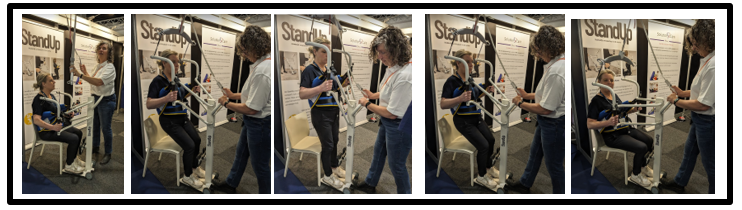






StandUp: Standing Up safely
A ceiling-hoist with sit to stand lift that encourages clients to move and support care professionals
Care organisations are under pressure from a growing shortage of qualified staff and increasing demand for care. At the same time, the need for safe, efficient and person-centred care continues to grow. Assistive devices that support movement rather than take over play an important role in meeting this need.
StandUp was developed in response to these everyday challenges. It is a ceiling-hoist sit-to-stand lift that supports clients in a natural standing-up movement and reduces the physical strain on care professionals during transfers.
Future-focus
Practical safety
Supporting independence
The idea behind StandUp
In everyday care, helping clients stand up safely often requires considerable physical effort from care professionals, while clients benefit from retaining as much control as possible. StandUp brings these two needs together.
The device supports the natural sit-to-stand movement, allowing clients to remain active wherever possible. At the same time, StandUp is easy to operate and requires minimal physical effort, enabling care professionals to work safely without additional steps or complex instructions.
Wat StandUp contributes
StandUp helps care organisations to:
- Support clients’ independence
- Reduce physical strain on care professionals
- Enable safe and efficient transfers
- Free up time for direct care
When to choose StandUp
StandUp is not a solution for every situation. It is a deliberate choice for care organisations that look beyond the short term and are willing to organise care differently.
In practice, StandUp is primarily chosen by organisations seeking sustainable solutions to staff shortages, physical strain and rising care costs. Combining a ceiling-hoist system with StandUp and complementary assistive devices creates the ‘ceiling-based care system’.
This offers a different way of working: less lifting, more guidance, and support with both static and dynamic physical loads. This can reduce the need for a second care professional.
The ceiling-hoist care system as a second care professional.
Practical safety
Supporting independence
Strategic choice
Long term cost effectiveness
Organisations using this approach find that long-term cost-effectiveness is a decisive factor. While mobile lifts primarily address individual care tasks, a ceiling-hoist system with StandUp provides ongoing support.
In one real-world example, a residential care centre with 52 beds achieved savings of more than €100,000 over 30 years, while also investing in safety, comfort and ease of use.
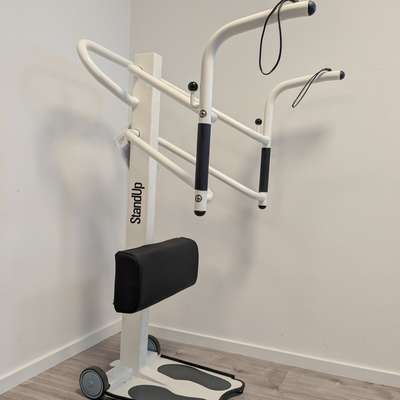
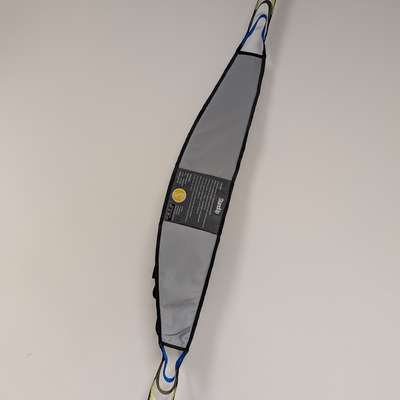
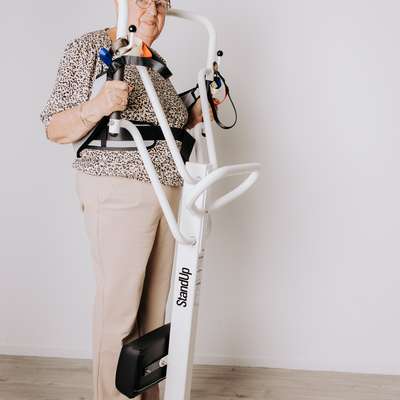
StandUp helps the client stand up using a natural movement. Watch here. StandUp in praktijk
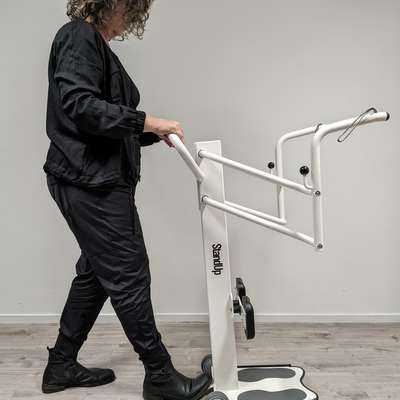
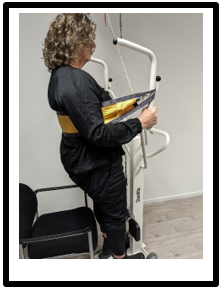
Tilting StandUp
Place your foot on the foot step and tilt the lift. The large wheels are designed to move the lift towards or away from the client, serving as transport wheels.
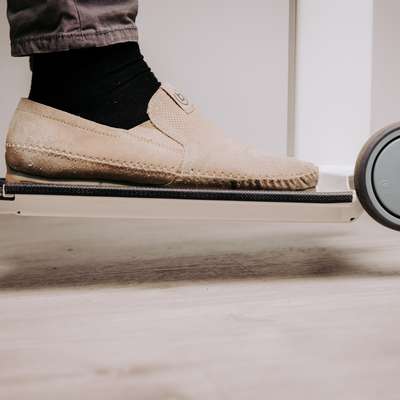
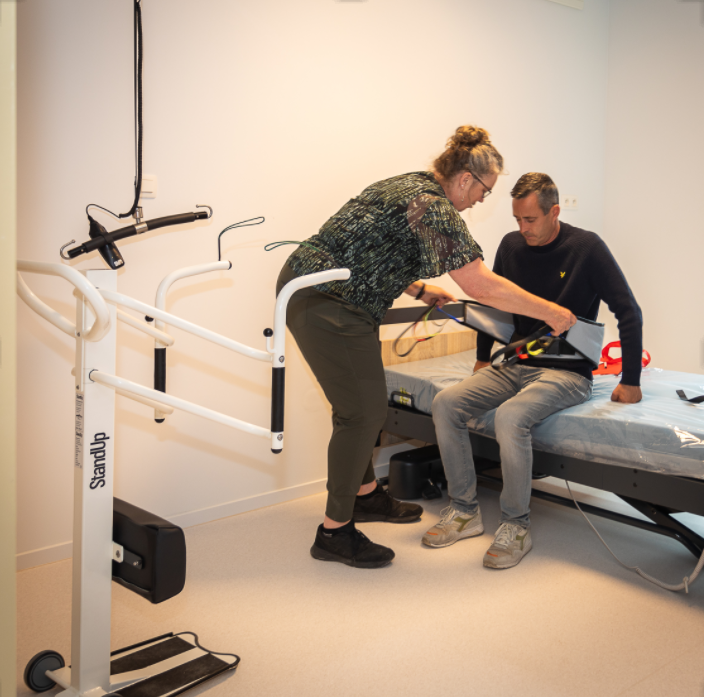
Positioning the StandUp sit-to-stand lift
If you look closely at this photo, you can see small wheels at the front. Together with the rear wheels, these allow you to move the footplate straight towards the client’s feet.
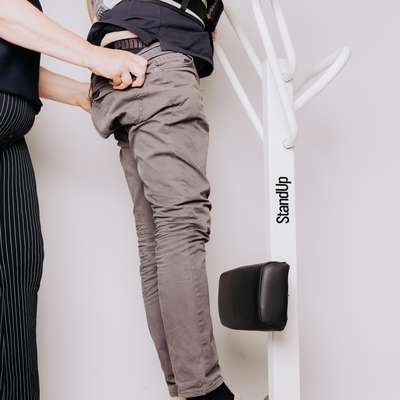
Dressing and undressing
With the ceiling-hoist-sit-to-stand lift suspended 1–5 cm above the floor, you can safely help the client get dressed or undressed. The footplate is deliberately NOT lowered onto the floor, as this would allow the lift to roll.
StandUp requires a long-term vision
A deliberate choice for continuity, practical working conditions and future-ready care

This choice also requires courage and vision. The initial investment in a ceiling-based care system is higher than the cost of replacing existing mobile lifts. StandUp is therefore particularly suited to organisations that:
- Are willing to invest for the long term
- Want to take a preventive approach and reduce the strain on care professionals without compromising quality
- Want to support clients’ independence
- View care as a process in which assistive devices, workflows and funding are interconnected
This way of working does not always fit with short-term thinking or investment models that demand quick returns. That is precisely why StandUp is often chosen by organisations committed to continuity, practical working conditions and future-ready care.
StandUp is therefore a strategic choice. A choice for care that remains safe, for staff who can sustain their work, and for organisations that want to maintain control over both quality and costs.
What is a StandUp ceiling hoist sit to stand lift?
+The StandUp ceiling-hoist sit-to-stand lift is an assistive device that helps clients actively participate in standing up and transferring via a ceiling-mounted rail. Rather than lifting the client, the system supports their natural sit-to-stand movement.
Which clients is StandUp suitable for?
+StandUp is intended for clients who:
- Can still stand, at least partially
- Can bear weight on at least one leg
- Have sufficient trunk stability
- Understand what standing means
This corresponds to clients in mobility class C.
How does it differ from a mobile sit-to-stand lift?
+The difference lies not only in the device, but also in the way care is delivered:
- No pushing or pulling
- No manoeuvring in confined spaces
- Always available via the ceiling rail
- Fewer steps
- The ability to stay close to the client while providing support
The result: easy movement around the room, safety and a sense of familiarity.
What benefits does a StandUp ceiling-hoist sit-to-stand lift offer?
+In practice, we see three clear effects:
- Less physical strain → less staff absence
- Time savings → up to several hours per day per unit
- Lower maintenance costs
Together, these translate into annual savings per employee.
Is StandUp difficult to use?
+No. StandUp has been specifically designed to be:
- Easy to operate
- Effortless to move
- Intuitive to use
This allows care professionals to quickly start working independently.
Do I always need a ceiling hoist?
+Yes. StandUp is used in combination with an approved ceiling hoist fitted with a two-point spreader bar. The system cannot function without a ceiling hoist.
Is it suitable for small spaces?
+This is precisely where it excels. Because the lift moves along the ceiling rail:
- The floor stays clear
- No floor-based chassis is needed
- Positioning becomes easier
Ideal for bathrooms and small rooms.
Can the client still actively participate?
+Yes — that is exactly the aim. StandUp supports the client when standing up and while standing, encouraging them to participate in the movement and use their own muscle strength.
Is StandUp safe to use?
+Yes, provided it is used correctly, with:
- A risk assessment before use
- Appropriate client selection
- Proper staff instruction
Under these conditions, it can be used safely, ergonomically and responsibly.
When should you not choose StandUp?
+When a client:
- Cannot stand on at least one leg, and/or
- Has insufficient trunk stability, and/or
- Cannot follow instructions
In these cases, another solution, such as a sling attached to the two-point spreader bar, is more appropriate.
Sometimes a client can use StandUp for transfers from a wheelchair, but not from a bed because they lack sufficient trunk stability when sitting on the edge of the bed. In this situation, the existing ceiling lift and two-point spreader bar can be used with a sling for transfers into and out of bed, while StandUp can be used for the rest of the day.
How quickly does StandUp pay for itself?
+This depends on how it is used, but in practice, savings come from:
- Time saved
- Being able to work alone, saving the care time of a second professional
- Reduced sickness absence, with a day of absence costing an average of €350
- Lower maintenance costs
StandUp often pays for itself within a few years. Its purchase price is also considerably lower than that of a mobile sit-to-standing aid or an electrically driven sit-to-standing aid.
How can one choice of assistive equipment meet both current and future care needs at home?
+In practice, assistive devices are often selected based on the client’s current situation. When their care needs change, this often means:
- A new needs assessment
- A new fitting
- Additional costs
- Further adjustments for both the client and the care professional
The question is whether this approach still fits with living at home with future care needs in mind.
Choosing a ceiling hoist as the foundation offers a different approach.
A ceiling hoist makes it possible to:
- Actively support clients when standing up, for example with StandUp
- Switch immediately to passive lifting when needed, without modifying the installed system
This means:
- No new fitting when the client’s condition deteriorates
- Continuity of care and use
- Less strain on the client and the care professional
- Above all: one investment that adapts as care needs change
“On 14 September, we received some great feedback from Woonzorgnet-Dijleland (WZND) in Belgium: “We are receiving more and more feedback that using StandUp instead of a mobile active sit-to-standing aid provides additional ergonomic support. This is particularly noticeable when moving residents around the room, even in confined spaces — for example, when transferring from a bed to a wheelchair positioned at a right angle beside it. Previously, the mobile sit-to-standing aid first had to be moved backwards far enough to create sufficient turning space for the entire wheeled base to turn through 90°. The legs of the base then had to be spread to allow the lift to approach the wheelchair. With StandUp, all these steps are far less cumbersome and require less space and time!” Would you like to experience these benefits too?”

“A nursing home in Vlissingen had experience with the predecessor to the StandUp ceiling-hoist sit-to-stand lift. A client with paralysis on one side of the body could not be lifted safely using that device because the lifting frame tilted beneath the ceiling hoist suspension point. Passive lifting was therefore being considered. For this reason, the physiotherapist wanted to try the StandUp ceiling-hoist sit-to-standing aid. The result? The client stood comfortably upright in StandUp and immediately asked: “Can this sit-to-standing aid stay? Then I won’t have to use the sling lift.””

“At VEINEdagen 2026, physiotherapists, occupational therapists and care professionals tried out the StandUp sit-to-standing aid. Feedback was positive, particularly regarding how it supports clients in standing up and how easily it moves around the room. Some physiotherapists also felt that StandUp could potentially be used for mobilisation and rehabilitation.”

How does a ceiling hoist with a two-point spreader bar make care work easier?
+A ceiling hoist is more than a device for moving someone. When properly integrated into the care process, it helps reduce physical strain, improve client comfort and create a more manageable working environment.
At Vita Care, this starts with mapping the client’s care journey over 24 hours. For each care activity, we assess the tasks involved, the relevant mobility class and how to make the most of the client’s own abilities. We then determine the most suitable approach and assistive devices.
Research by LOCOmotion shows that ceiling hoist systems not only reduce physical strain during transfers, but also improve the quality of care and working conditions. Care professionals report fewer back, neck, shoulder and knee complaints and rate ceiling lift systems very highly. Transfers can also be carried out more quickly and comfortably.
A key advantage is that a ceiling hoist is always available. Care professionals do not need to find, fetch or manoeuvre a mobile lift in confined spaces. This saves time and reduces physical strain. They can also work closer to the client, reducing the need to spend extended periods in physically demanding postures.
A ceiling-based care system also makes it easier to coordinate transfers, repositioning in bed, continence care, skin care and other care tasks. A transfer becomes part of a comfortable and efficient care process, rather than an isolated task. This is why LOCOmotion now refers to a ceiling-based care system, rather than simply a ceiling lift system.
For clients, this means greater comfort, greater safety and less fatigue. For care professionals, it means less physical strain, greater job satisfaction and more time and attention for the client.
In this way, a ceiling-based care system supports what matters to Vita Care: manageable care that puts clients’ abilities at the centre and enables care professionals to continue working sustainably.
Sources:
- Van plafondtilsysteem naar plafondzorgsysteem [From a Ceiling Lift System to a Ceiling-Based Care System], LOCOmotion, November 2021.
- Businesscase Plafondtilliften, kosten en baten in beeld [The Business Case for Ceiling Lifts: Costs and Benefits], commissioned by RegioPlus, LOCOmotion, 2023.
Do we need a new ceiling lift?
+Not necessarily. StandUp can be used with an existing ceiling lift if it meets the technical requirements. These include a suitable two-point spreader bar, sufficient lifting height and an adequate safe working load. Have the combination checked before use; not every ceiling lift is automatically suitable.
Can StandUp be used with both a two-point and a four-point spreader bar?
+No. According to the manufacturer’s requirements, StandUp must be used with an approved ceiling lift fitted with a suitable two-point spreader bar. A four-point spreader bar is not listed as an approved combination in the StandUp brochure.
However, the organisation can replace the four-point spreader bar with a two-point spreader bar that meets the following requirements:
- The suspension points must be 52–58 cm apart, measured centre to centre.
- The suspension loops must not be able to detach unintentionally from the suspension points.
- The ceiling lift must have a sufficient safe working load to accommodate the client’s weight plus 20 kg for StandUp and the back support strap. For the maximum client weight of 150 kg, a safe working load of at least 170 kg is required.
- There must be at least 190 cm of clear lifting height beneath the suspension point, allowing StandUp to be lifted completely off the floor.
Have the ceiling lift and two-point spreader bar checked for compatibility with StandUp before use.
What benefits does StandUp offer our care organisation?
+
StandUp helps staff carry out active transfers with clients in mobility class C, with minimal physical strain and less space needed to move within the area covered by the ceiling rail.
As part of a suitable ceiling-based care system with a ceiling lift and a two-point spreader bar, staff can help clients stand up, put on or remove lower-body clothing for activities such as toileting, and move without resistance. The results depend on client selection, the rail layout and the team’s working practices.
Can using StandUp with a ceiling lift help reduce musculoskeletal complaints among care staff?
+
StandUp moves along the ceiling rail, so staff do not need to manoeuvre a wheeled base carrying the client across the floor during transfers. They can also work close to the client. This helps limit physical strain.
A field study at care organisation SVRZ found the following reductions in complaints among care staff after mobile lifts were replaced with ceiling lift systems, combined with staff training:
- 18% fewer back complaints
- 42% fewer knee complaints
- 26% fewer neck, shoulder and arm complaints combined
These results relate to the implementation of ceiling lift systems examined in the study. They are not independently demonstrated results for StandUp and do not guarantee the same outcomes for every care organisation. Suitable equipment, training and correct use in everyday care are essential.
Source:
- Gezond & Zeker / LOCOmotion, research into ceiling hoist systems at SVRZ, commissioned by RegioPlus.
- Factsheet
- Read SVRZ’s own experiences here.
What changes for care staff?
+During transfers, staff no longer need to push a mobile sit-to-standing aid carrying the client across the floor or manoeuvre it around a bed, chair or toilet. StandUp moves along the ceiling rail. Without wide base legs, staff can work closer to the client and provide support more easily.
Can one care professional use StandUp?
+StandUp is designed to allow one care professional to carry out suitable transfers and care tasks. Whether this is safe and appropriate for a particular client depends on their abilities, the care situation and the risk assessment. Staff must receive instruction and follow the agreed working procedures.
Which clients is StandUp suitable for?
+StandUp is intended for clients who can bear weight on at least one leg, have sufficient trunk stability and understand what standing means. This group is also referred to as mobility class C.
The maximum user weight is 150 kg, and StandUp is designed for clients approximately 150–190 cm tall. Always assess suitability for the individual client and the specific transfer.
What happens if the client becomes less able to participate actively?
+Reassess which type of transfer support is appropriate. When actively standing up is no longer safe, a suitable sling attached to the ceiling lift may offer an alternative. The same ceiling system can therefore provide different forms of support, provided the lift, spreader bar and sling are suitable.
What does the client experience when using StandUp?
+The client is supported through a natural movement from sitting to standing and back again. Their own abilities are used: the client bears weight on at least one leg and participates actively. The care professional can remain close, which can contribute to comfort, personal contact and a sense of security.
Is StandUp also suitable for smaller rooms and bathrooms?
+The absence of a wide base makes StandUp a space-saving solution. It has a turning circle of approximately 80 cm and requires approximately 80–100 cm of working space on one or both sides of the bed. We assess whether the solution fits based on the rail layout, the room’s furnishings and the space needed by the care professional.
What maintenance does StandUp require?
+The StandUp sit-to-stand frame has no motor of its own. It requires an annual inspection, and the suspension loops must be replaced every two years. StandUp comes with a five-year warranty; see the user manual.
The ceiling hoist has its own maintenance and inspection requirements. Include both components in the maintenance plan.
Is StandUp more cost-effective than a mobile sit-to-stand lift?
+
This depends on the existing facilities and how the equipment is used. Compare the total cost of StandUp and the ceiling lift system, including rails and a two-point spreader bar, with the cost of mobile lifts.
Also consider maintenance, inspections, the risk of musculoskeletal complaints and staff absence, and everyday working practices. Having a suitable ceiling system already installed creates a different starting point from needing a new installation.
Burenhof in Leuven, a care home with 52 beds, chose Lopital Luna ceiling lift systems with two-point spreader bars and eight StandUp sit-to-stand lifts. This will save them at least €100,000 over 30 years.
Request a quotation for StandUp, including the back support strap.
How can we find out whether StandUp is right for our organisation?
+Begin met de dagelijkse transfers: welke cliënten kunnen actief meewerken, waar moeten medewerkers manoeuvreren en welke plafondvoorzieningen zijn aanwezig?
Een demonstratie in de eigen zorgomgeving helpt om de meerwaarde voor cliënten en medewerkers te beoordelen. Neem contact op voor advies of een demonstratie.